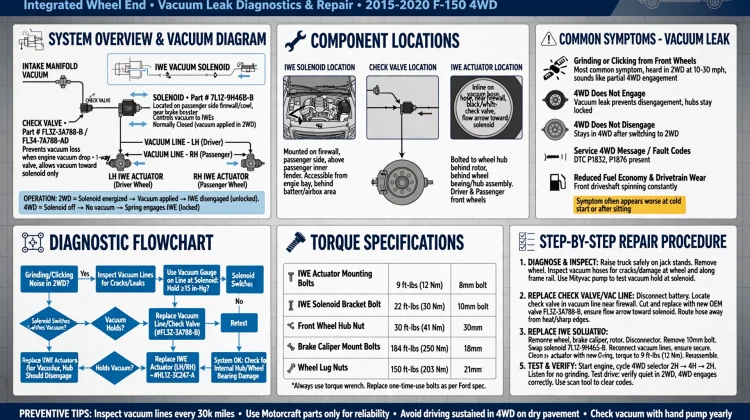
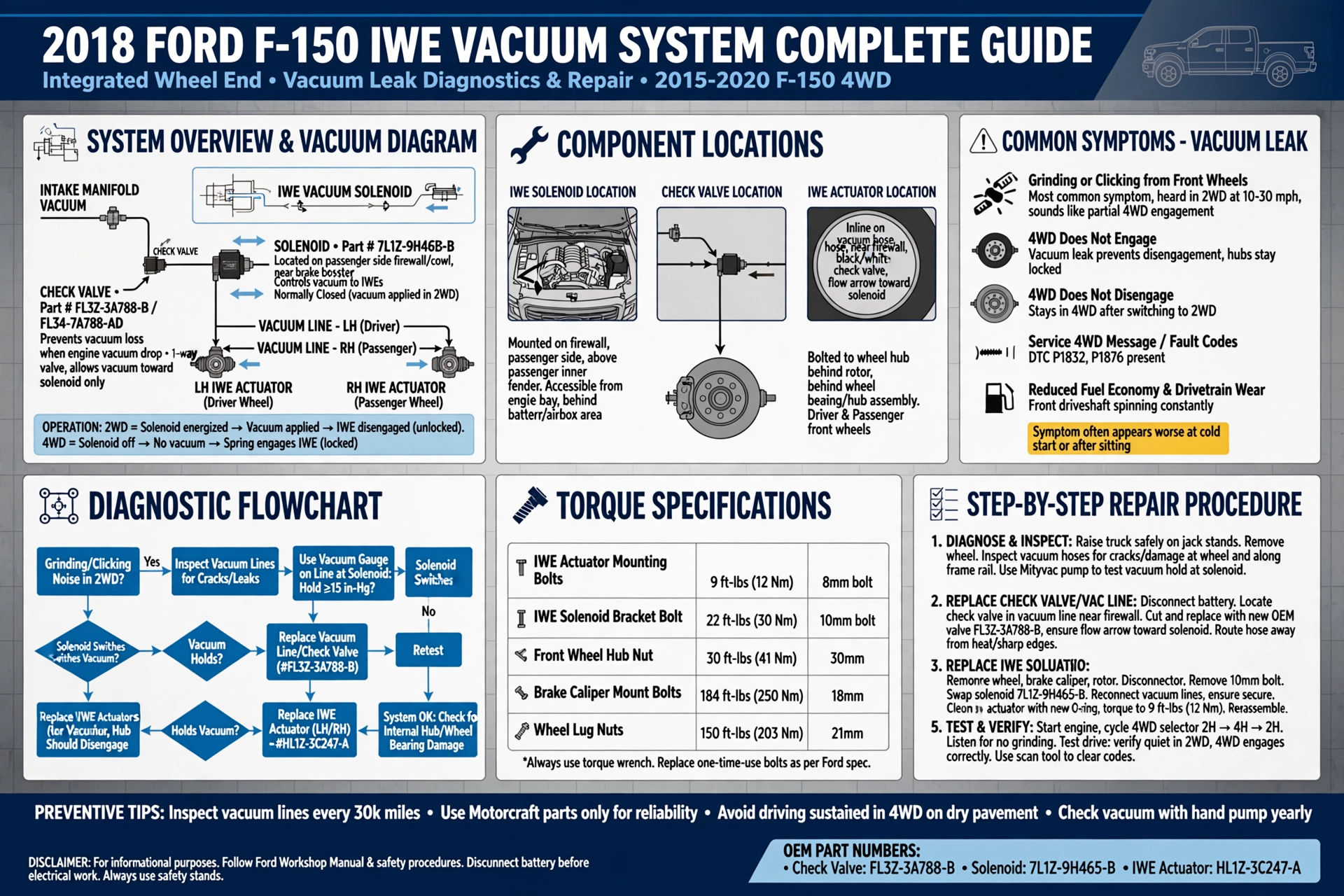
Here’s the deep detailed 2018 F-150 IWE guide + poster — this is the exact vacuum diagram for your truck:
2018 F-150 IWE DEEP GUIDE
2018 is unique: Your truck has the old-style solenoid mounted opening UP on passenger firewall – rain fills it. Ford issued SSM 47773 and updated part 7L1Z-9H465-B with cover. If you still have FL3Z-9H465-A, that’s your leak 90% of the time.
1. SYSTEM EXPLAINED – 2018 Specific
– Source: Intake manifold vacuum (or vacuum pump on 3.5L EcoBoost) → Check valve FL3Z-3A788-B → Reservoir behind battery → IWE Solenoid 7L1Z-9H465-B → T fitting at frame → Left/Right IWEs
– Operation: 2WD = solenoid ON = vacuum to IWE = hub DISENGAGED. 4WD = solenoid OFF = vent to atmosphere = spring locks hub.
– When leak: Partial vacuum = IWE half-engaged = grinding at 15-40 mph.
2. 2018 SYMPTOMS CHECKLIST
– Grinding/clicking front wheels in 2WD, stops when you switch to 4A/4H → 100% IWE
– Worse on cold start, disappears after warmup
– Intermittent — can be fine for days then grind
– Vacuum hiss near battery
– 4WD fault light after extended grinding
– 2018 Test: While grinding, switch to 4H — if noise stops instantly, vacuum leak confirmed.
3. DIAGNOSIS FOR 2018 – Use Mityvac MV8000
Step A – Solenoid output test:
Engine running, 2WD, pull output line off solenoid, connect gauge. Should read 16-22 inHg. Switch to 4H → must drop to 0 inHg in <3 sec. If not → replace solenoid + check valve.
Step B – System hold test:
Engine off, connect Mityvac to T at driver frame rail, pump to 20 inHg. Must hold 5 min. If drops:
– Pinch left line → holds? Left IWE bad
– Pinch right line → holds? Right IWE bad
– Both pinched still drops? Main line or solenoid leaking
Step C – IWE direct test:
At wheel, pull line off IWE, connect Mityvac to IWE nipple, pump 20 inHg. Should hold and wheel spins free. Release → loud CLUNK and wheel locks. If won’t hold = IWE torn (water inside).
4. 2018 FIX – Do in this order
Fix 1 – $52 – Fixes 80% of 2018s:
1. Disconnect battery
2. Replace check valve FL3Z-3A788-B / FL34-7A788-AD — arrow points TO solenoid/reservoir. Common installed backwards.
3. Replace solenoid with updated 7L1Z-9H465-B — mount with vent DOWN, add dielectric grease to connector per TSB
4. Replace rubber hose from solenoid to frame — 2018 hose melts on 3.5L turbo
Fix 2 – IWE Actuator Replacement:
– Part: HL1Z-3C247-A (fits both sides, 2015-2020)
– 8mm bolts: 9 ft-lbs (12 Nm) — DO NOT overtighten, aluminum knuckle strips
– Hub nut: 30 ft-lbs (41 Nm) 30mm
– Caliper mount: 184 ft-lbs (250 Nm) 18mm
– Lug nuts: 150 ft-lbs (203 Nm)
– Clean knuckle face, light anti-seize on splines, new O-ring on IWE
Fix 3 – Permanent Delete (for lifted/off-road):
Install Dorman 600-405 IWE delete — locks hubs permanently. Lose 0.5 mpg, never grind again. Many 2018 Raptor owners do this.
5. POST-REPAIR VERIFICATION
1. Vacuum holds 20 inHg for 5 min engine off
2. Cycle 2H→4H→2H 10 times — vacuum responds instantly
3. Road test 5 miles 2WD at 40 mph, hard left/right turns — no noise
4. Cold start next morning — this is real test
5. Clear codes with scanner: P1832/P1876 if set
Prevent 2018 repeat failure: Every 30k miles, inspect vacuum line where it touches battery tray — zip tie away. Spray silicone on IWE boots to prevent water intrusion.
What’s your engine — 2.7L, 3.5L EcoBoost, or 5.0L? On 3.5L 2018, there’s also an electric vacuum pump on rear of engine that fails and causes same symptom. I can give you pump test if you have 3.5L.
What the Above Guide Gets Right
-
Symptoms: Accurately describes the front-end grinding/clicking in 2WD that stops when shifting into 4H/4A.
-
Vacuum Diagnostic Testing: The Mityvac testing steps (testing solenoid output, line retention, and hub actuator holding pressure at 20 inHg) are spot-on.
-
Torque Specs: Correctly lists crucial specs like the 8 ft-lbs (9 Nm) for the IWE mounting bolts (which strip easily) and 30 ft-lbs (41 Nm) for the axle spindle nut.
Where It Falls Short
-
Misses Ford’s Updated TSB Fix (TSB 20-2307):
-
Ford updated its official fix for 2015–2020 F-150s with 4A (Torque-On-Demand / TOD transfer case) trim levels (Lariat, King Ranch, Platinum, Limited).
-
Instead of constantly replacing failing vacuum lines and solenoids, Ford’s official service bulletin instructs technicians to cap and remove the vacuum supply lines entirely, leaving the hubs permanently locked. This eliminates grinding without sacrificing 4WD functionality or noticeably impacting MPG on TOD models.
-
-
Missing Key 2018 Warm-Up Strategy:
-
On 2018+ F-150s, Ford programmed the Transfer Case Control Module (TCCM) to keep the IWEs locked for the first 0.5 miles of driving after every engine start to warm up the front differential fluid before pulling vacuum. The guide does not account for this built-in behavior during testing.
-
-
Incomplete EcoBoost Vacuum Pump Info:
-
It mentions the mechanical/electric vacuum pump on the 3.5L EcoBoost but omits the 2.7L EcoBoost’s engine-driven vacuum system setup.
-
Complete 2018 Ford F-150 IWE Diagnostic & Repair Guide 2
1. How the System Works
-
2WD Mode: Engine vacuum pulls the hub gear outward (disengaging front axle shafts to save fuel).
-
4WD Mode: Vacuum solenoid shuts off, venting the line. Internal springs push the hub gear inward to lock the front axles to the wheel hubs.
-
Partial Vacuum (The Grind): A tiny leak causes the spring to partially engage the teeth while moving, producing a loud metal-on-metal ratcheting/grinding sound.
2. Quick Diagnostic Sequence
Test 1: On-Road Verification
-
Drive until you hear the grinding/clicking noise (typically around 15–40 mph under acceleration).
-
Switch immediately from 2H to 4H (or 4A).
-
Result: If the noise disappears instantly, you have a vacuum loss or failing IWE actuator.
Test 2: Check Valve Test (Most Common Failure)
-
Locate the black and white check valve (
FL3Z-3A788-B) on the driver’s side vacuum line near the brake booster/solenoid. -
Remove it and blow through both ends:
-
Pass: Air should flow in one direction only (towards the engine/vacuum source).
-
Fail: If air flows both ways or neither way, replace it (~$12–$15 part).
-
Test 3: Vacuum Hold Test with Hand Pump (Mityvac)
-
IWE Actuators (At Wheels): Disconnect the vacuum line at the back of each front wheel hub. Apply 15–20 inHg of vacuum directly to the large port on the actuator.
-
Requirement: Must hold steady vacuum for 5 minutes. If pressure drops, the internal diaphragm is torn and the IWE must be replaced.
-
-
Vacuum Lines: Apply 15–20 inHg to the main line running down to the wheels. If it bleeds down, a vacuum line is cracked, melted, or rubbed through.
3. Repair Options & Solutions
Option A: The Factory Vacuum Repair (Standard Fix)
If you want to maintain full factory operation:
-
Replace the Check Valve (
FL3Z-3A788-B). -
Replace the IWE Solenoid (
7L1Z-9H465-B). -
Replace damaged IWE Actuators (
HL1Z-3C247-A).-
Installation Tip: Apply vacuum to the new IWE during installation before tightening the spindle nut. If you torque the axle nut without vacuum applied, you can crush the plastic teeth inside the new actuator.
-
Option B: Ford TSB 20-2307 Method (For 4A / TOD Transfer Cases)
If your truck has 4A (4-AUTO) on the transfer case dial:
-
Remove the vacuum source line between the engine and the IWE check valve.
-
Install Ford vacuum caps (
W716372-S300) over the open ports at the check valve and supply line. -
Result: Front hubs remain engaged 100% of the time (like 2500/3500 heavy-duty trucks). Transfer case still handles 2WD/4WD switching electronically. MPG loss is minimal (0.2–0.5 MPG), and grinding is permanently fixed.
Option C: Unplugging the Solenoid (Emergency Temporary Fix)
-
If you are on a trip and hear grinding, pull over and unplug the electrical connector on top of the IWE vacuum solenoid near the brake booster.
-
This vents vacuum and safely locks the hubs in place to prevent destroying the gear teeth until you can repair the system.
Torque Specifications Reference
-
IWE Actuator-to-Knuckle Bolts (3x 8mm): 9 ft-lbs (12 Nm) (Do not over-torque)
-
Axle Spindle/Hub Nut: 30 ft-lbs (41 Nm)
-
Brake Caliper Bracket Bolts: 184 ft-lbs (250 Nm)
-
Wheel Lug Nuts: 150 ft-lbs (203 Nm)