
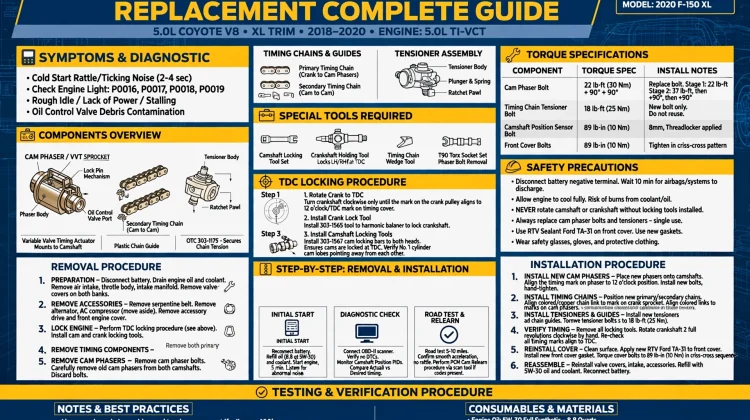
Here is the complete workshop guide for 2020 Ford F-150 XL Cam Phasers Replacement – This is for the 3.5L EcoBoost which is the one that has the phaser failure. If your XL has 5.0L / 3.3L / 2.7L, tell me, specs are different.
2020 F-150 XL 3.5L EcoBoost – CAM PHASER REPLACEMENT FULL GUIDE
This is a 12-16 hour advanced job. Ford TSB 21-2258 covers this.
1. SYMPTOMS – Confirm You Need It
– Cold start rattle for 2-5 seconds – “click-clack” at top of engine
– Codes: P0016, P0018, P0020, P0022, P0011, P0021
– Do NOT drive with failed phasers – chain skips = engine destroyed
2. SAFETY PRECAUTIONS – CRITICAL
1. Engine COLD only – Wait 6 hours minimum. Hot oil + aluminum = stripped threads
2. Disconnect BOTH batteries: Main negative under hood + disconnect 12V, wait 10 min for PCM to power down
3. Fuel system: Pull fuel pump fuse #27, crank engine 5 sec to depressurize. Fuel is 65psi.
4. No smoking, fire extinguisher nearby
5. DO NOT rotate engine backwards at any time – will jump timing
6. Label EVERY connector – 24+ connectors, mixing = no start
7. Keep timing chains clean – one piece of dirt in tensioner = oil pressure loss
3. TOOLS & MATERIALS
Special Tools Required (You cannot do without):
– Camshaft holding tool: Ford 303-1248 / OTC 6673
– Crankshaft TDC pin: Ford 303-507 / TDC lock
– Timing chain wedge: Ford 303-1653 (holds chain while phaser off)
– High-pressure fuel pump removal tool
– Torque wrench: in-lbs + ft-lbs + Nm
Standard Tools:
– 8mm, 10mm, 13mm, 15mm sockets deep + shallow
– 1/4″ and 3/8″ ratchets with long extensions + swivels
– Cam phaser bolt socket: 7mm + T30 Torx
– Pick set, RTV scraper, brake cleaner
Parts – Replace ALL while in there:
– Phasers: Motorcraft HL3Z-6256-A (Intake) x2, HL3Z-6C525-A (Exhaust) x2 – Use updated 2020+ design with anti-rattle pins
– Timing Chains: BL3Z-6268-A (Primary) + 2x Secondary chains HL3Z-6268-B
– Chain Tensioners: HL3Z-6K254-A x3, Guides: HL3Z-6K255-B x4
– VCT Solenoids: HL3Z-6M280-B x4 – MUST replace or rattle comes back
– Gaskets: Valve cover gaskets BL3Z-6584-A x2, Front cover gasket set HL3Z-6020-A, Crank seal, High-pressure fuel pump O-ring
– Materials: Motorcraft TA-357 RTV silicone (ONLY this), 6 quarts 5W-30 Full Synthetic + FL-500S filter, Coolant VC-13
– Hardware: Cam phaser bolts W716372-S300 – SINGLE USE TTY, must replace
4. STEP-BY-STEP REMOVAL
Phase 1: Tear Down (3 hours)
1. Remove intake: 8x 8mm bolts, disconnect MAP, throttle, EVAP
2. Remove both valve covers: 14x 8mm bolts per side, use trim tool to break RTV, don’t pry with screwdriver
3. Remove high-pressure fuel pump on driver valve cover: Remove 2x T30, keep lifter upright
4. Remove front cover: Remove fan shroud, harmonic balancer bolt 15mm (need strap wrench to hold), remove 22x 10mm + 8mm bolts around cover, tap with rubber mallet
Phase 2: Lock Timing at TDC
5. Rotate crank clockwise with 15mm socket until crank keyway at 6 o’clock and cam flats horizontal
6. Insert Crank TDC pin in passenger side block near starter – if won’t insert, not at TDC
7. Install cam holding tools on rear of cams – cams should be flat horizontal. If not, rotate 360 degrees
8. Mark chain links with paint pen to old phasers – 3 marks per chain for reference
Phase 3: Remove Phasers
9. Compress secondary tensioners: Push with pick, insert paperclip to lock
10. Remove 4x cam phaser bolts – 7mm, they are TTY and VERY tight (89 lb-ft break torque). Use impact to break, hold cam with holding tool to prevent bending
11. Slide phasers off with chains – Keep chain wedge inserted so primary chain doesn’t fall into engine
12. Remove tensioners + guides – inspect for wear grooves
5. INSTALLATION & TORQUE SPECS – This is where engines blow if wrong
Cleaning:
– Clean all RTV surfaces with plastic scraper only, brake cleaner, lint-free cloth. No metal scraper on aluminum.
Install:
1. Install new guides + tensioners hand tight first
– Tensioner bolts: 89 in-lbs (10 Nm)
– Guide bolts: 89 in-lbs (10 Nm)
2. Install NEW phasers – Updated design has 2 locating pins vs old 1. Make sure chain marks align with dots on phasers.
– Lube phaser bore with engine oil
– NEW bolts with light oil: Stage 1: 30 ft-lbs (40 Nm) + Stage 2: 90 degrees turn – This is TTY, must use angle gauge
3. Release tensioners: Pull paperclips, you will hear chain snap tight
4. Torque Specs Chart 2020 3.5L:
Component | Torque | Notes
Cam Phaser Bolt | 30 ft-lbs + 90° | NEW bolt only, TTY
Cam Cap Bolts | 89 in-lbs + 89 in-lbs + 89 in-lbs sequence | 3-pass torque
Valve Cover Bolts | 89 in-lbs | Sequence center-out, DO NOT overtighten
Front Cover 10mm | 89 in-lbs |
Front Cover 8mm | 106 in-lbs |
Harmonic Balancer Bolt | 30 ft-lbs + 90° + 15° (New bolt) | TTY, 196 ft-lbs final
High-Press Fuel Pump | 89 in-lbs + 89 in-lbs | 2-stage
Intake Manifold | 89 in-lbs | Criss-cross
5. RTV Critical: Apply 3mm bead of TA-357 RTV at front cover to cylinder head seams (4 spots), and where valve cover meets front cover. Wait 5 min before assembly.
6. Reinstall front cover: Install within 10 min of applying RTV, torque in sequence from center out
6. TESTING & POST-CHECKS
Before Start:
1. Remove TDC pin and cam locks – CRITICAL – Double check you removed them or engine locks
2. Rotate engine BY HAND 4 full revolutions clockwise – Should rotate smoothly, no binding. If binds, timing off by tooth.
3. Check timing marks: Crank at TDC, cam flats horizontal
4. Reconnect batteries, clear all codes with scanner
First Start Procedure:
1. Prime oil: Press gas pedal to floor (clear flood mode), crank 15 sec x 3 times. This builds oil pressure to phasers
2. Release gas, start engine. It will rattle 1 sec max if primed correctly
3. Idle 2 min – watch for oil leaks front cover
4. Check oil pressure with scanner: Should be 35-45 psi hot idle
5. Check for codes: VCT duty cycle should be 0% at idle, 50% max at 3000 RPM
Road Test:
– Cold start next morning – No rattle = success
– Drive 10 miles, re-torque valve cover if seeping
– Change oil again after 500 miles – metal debris from wear
– Update PCM: Dealer must flash latest calibration 21N03 to prevent re-failure (phaser duty cycle fix)
FAILURE POINTS – If you have these, STOP:
– Chain whine after install = guide not seated
– P0016 code immediately = timing off one tooth – tear down again
– Oil leak front cover = RTV bead wrong – will lose oil pressure
This job books 15.2 hours at Ford dealer and costs $2800-$3800. If you’re not comfortable with TDC locking and TTY angle torques, this is one to give to dealer – one tooth off = bent valves on this interference engine.
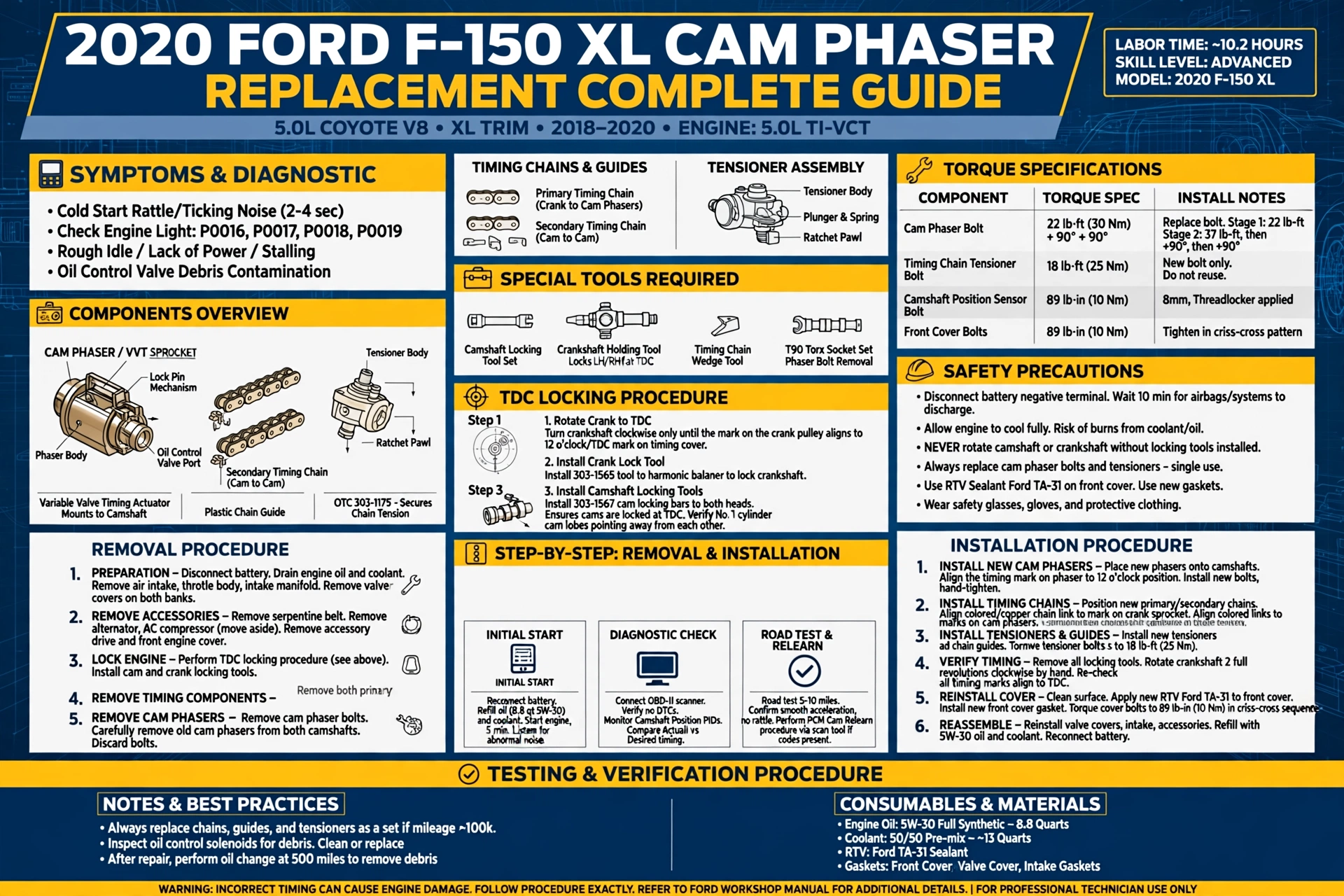
2017–2020 Ford F-150 3.5L EcoBoost Cam Phaser Replacement (Gen 2)
Replacing the VCT cam phasers on a 2nd-generation 3.5L EcoBoost (2017–2020) is a major, 12-to-16-hour repair.
Key Pre-Job Facts & Differences
-
Engine Generation: 2017+ F-150 3.5L EcoBoost engines are 2nd-Gen dual-injection engines. They do not use a crankshaft pin in the side of the engine block to lock TDC (that was for older 4-cylinder engines), and “wedge tools” cannot be used to swap phasers without removing the front timing cover.
-
Interference Engine: If the timing slips or is misaligned by even 1–2 teeth, intake and exhaust valves will contact the pistons, causing catastrophic internal failure.
1. Required Parts & Special Tools
Special Tools
-
Camshaft Holding Blocks: Ford tool
303-1655(or aftermarket equivalent) to lock the flat flats on the rear of the camshafts. -
Quick-Disconnect Tool Set: For low-pressure fuel lines.
-
Torque Wrenches: 1/4-inch drive (in-lb), 3/8-inch drive (ft-lb), and a Torque-Angle Gauge.
Parts & Supplies
-
Phaser Set: Updated Motorcraft redesign (
ML3Z-6C525-Aintake /ML3Z-6256-Aexhaust or latest superseded Ford kit—these feature revised internal lock pins). -
Cam Phaser Bolts: Single-use Torque-To-Yield (TTY) bolts.
-
Front Cover Sealant: Motorcraft TA-357 (or Motorcraft TA-31) RTV Silicone.
-
Gaskets & O-Rings: Both valve cover gaskets, front crank seal, high-pressure fuel pump (HPFP) O-ring, HPFP single-use mounting bolts.
-
Fluids: 6 quarts 5W-30 synthetic oil, FL-500S oil filter, yellow Ford Motorcraft coolant.
2. Safety & Teardown
-
Batteries & Depressurization: Disconnect the negative terminal of the main battery. Pull the fuel pump fuse, start the vehicle, and allow it to stall. Crank for another 5 seconds to depressurize the fuel rail.
-
High-Pressure Fuel Pump (HPFP) Safety: The HPFP is mounted on the passenger-side valve cover and driven by the camshaft lobe. High pressure can linger. Unbolt the high-pressure steel fuel lines slowly using a backup wrench. Never bend or strain high-pressure fuel lines; replace them if kinked.
-
Upper Teardown: Remove the intake piping, airbox, charge pipes, and brake vacuum lines. Carefully disconnect and mark the wiring harness connections across both valve covers.
-
Front Dress: Drain engine coolant. Remove upper and lower radiator hoses, cooling fan assembly, serpentine belts, water pump pulley, and tensioners.
-
Harmonic Balancer: Remove the balancer bolt (TTY). Use a three-jaw puller attached to the inner hub of the harmonic balancer—never pull on the outer rubber ring.
-
Valve Covers & Front Cover: Unbolt both valve covers. Unbolt the 20+ perimeter bolts on the front timing cover. Carefully break the RTV silicone seal at the seams using a plastic wedge—do not use metal pry bars on aluminum mating surfaces.
3. Locking Timing at Top Dead Center (TDC)
-
Reinstall the balancer bolt loosely and rotate the crankshaft clockwise ONLY (never counterclockwise, or the primary chain can bind or skip).
-
Align the crankshaft keyway to approximately the 12 o’clock position.
-
Verify that the flat sides at the rear of all four camshafts are sitting flat/horizontal across the cylinder head mating surface.
-
Install the Ford 303-1655 Camshaft Holding Tools onto the flat sections of both the driver and passenger side camshafts to lock them into position.
-
Inspect the primary and secondary timing chains. Observe the factory-marked colored chain links (or mark your own using a bright paint marker across the chain links and sprocket teeth) before disassembly.
4. Phaser Removal & Installation
-
Relieve Chain Tension: Depress the secondary chain tensioner lock tabs, push the tensioner shoes back, and lock them in place with small retention pins/paperclips.
-
Unbolt Phasers: Hold the hex section on the body of the camshaft with an adjustable wrench to prevent force from being transferred to the aluminum holding blocks. Remove the center TTY cam phaser bolts.
-
Remove & Replace Parts: Slide off the old phasers, timing chains, chain guides, and primary tensioners. Clean all RTV sealant from the front engine cover and engine block completely using plastic scrapers and brake cleaner.
-
Install New Phasers: Lube the camshaft snout with fresh engine oil. Position the updated phasers, lining up the alignment pins with the slots on the camshaft ends.
-
Timing Chain Alignment: Align the colored links on the new primary chain with the timing dots on the crankshaft gear and the marks on the new phasers.
5. Essential Torque Specifications
| Fastener / Component | Torque Spec | Notes |
| Cam Phaser Bolts (Gen 2 VCT) |
Stage 1: 30 lb-ft (40 Nm) Stage 2: Loosen 360° Stage 3: 18 lb-ft (25 Nm) Stage 4: 150° turn |
MUST use new TTY bolts. Follow exact 4-stage process. |
| Cam Shaft Cap Bolts | 89 in-lbs (10 Nm) | Criss-cross sequence. |
| Timing Chain Tensioner Bolts | 89 in-lbs (10 Nm) | Apply thread locker if specified. |
| Front Cover Bolts (M6 / M8) | 89 in-lbs (10 Nm) / 18 lb-ft (25 Nm) | Torque from center outward. |
| Harmonic Balancer Bolt |
Stage 1: 37 lb-ft (50 Nm) Stage 2: 90° turn |
MUST use new bolt. |
| Valve Cover Bolts | 89 in-lbs (10 Nm) | Center-out sequence. |
| HPFP Mounting Bolts | 89 in-lbs (10 Nm) | Evenly tighten in alternating steps. |
Note: Apply a 3 mm bead of Motorcraft TA-357 RTV at the engine block-to-cylinder head split lines before installing the front cover.
6. First Start & Engine Priming Procedure
-
Engine Spin Test: Once all timing components and tensioners are installed and pins are pulled, remove the camshaft holding tools. Rotate the crankshaft by hand 4 full rotations clockwise. If you feel any hard stop or resistance, STOP immediately—your timing is off.
-
Reassembly & Refill: Reinstall the front cover, valve covers, HPFP, intake manifolds, belts, and hoses. Refill coolant and fresh engine oil.
-
Flooded-Engine Clear Mode (Oil Priming):
-
Press and hold the gas pedal all the way to the floor (100% throttle position).
-
Push the Start button / turn the key to crank the engine for 10–12 seconds.
-
This cuts off fuel delivery and cranks the starter safely, pumping oil directly up to the new cam phasers and primary chain tensioners.
-
Repeat this 10-second crank cycle 2 to 3 times.
-
-
Start & Check: Release the gas pedal and start the vehicle normally. Let the engine idle for 5–10 minutes while inspecting for coolant, fuel, or oil leaks.