
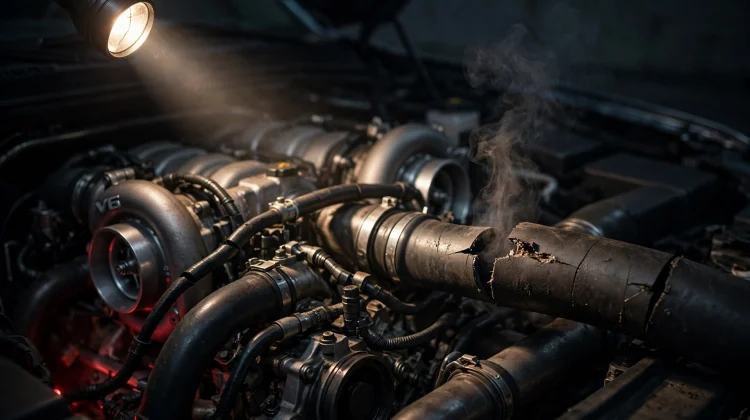
Your check engine light is on. Your truck feels a little… off. Maybe it idles rough. Maybe it hesitates when you hit the gas. Maybe it just drinks more gas than normal. You scan it. One code pops up: P0171 — System Too Lean (Bank 1) Don’t panic. Don’t replace your O2 sensor yet. 80% of people who get P0171 replace the WRONG part first and waste $200. Quick Answer: P0171 means your engine is getting TOO MUCH AIR or TOO LITTLE FUEL on Bank 1 — the side with Cylinder #1. The ideal ratio is 14.7 parts air to 1 part fuel. Your PCM has tried to add max fuel and still can’t fix it, so it throws P0171. On a 2018 F-150, the #1 cause is NOT the O2 sensor. It’s a vacuum leak (PCV hose / intake leak), a dirty MAF sensor, or on EcoBoost, a leaking intercooler boot / charge pipe. Fix in order: 1) Clean MAF (12),2)Findvacuumleak,3)Checkfuelpressure,4)CheckO2sensorLAST.YouCANdriveshort-term,butdoNOTdriveforweeks—lean=hot=meltedcatalyticconverter(800-$2,500).
1. What Does P0171 ACTUALLY Mean? (In Plain English)
Your engine is a controlled explosion machine. It needs exactly 14.7 parts air + 1 part fuel. That’s called Lambda = 1.0. If you have 16 parts air + 1 part fuel = LEAN. Too much air, not enough fuel. Engine runs hot, rough, weak. Your truck has O2 sensors in the exhaust that sniff the exhaust and tell the computer (PCM): “Hey, too much oxygen left over! We’re lean!” PCM says: “Okay, I’ll add more fuel.” It adds +5%, +10%, +20%, +25%… That’s called Fuel Trim. When it hits its limit — usually around +25% to +30% Long Term Fuel Trim — and STILL can’t fix it, it gives up and sets P0171. [OBDAdvisor — P0171 Expert Reviewed by ASE Master Tech Richard McCuistian] Think of it like this: You’re trying to fill a bathtub, but someone left the drain open. You turn the faucet to max, but the tub never fills. P0171 is the truck saying “Faucet is maxed, tub still empty, drain must be open.” The “drain” is either: Air sneaking in that wasn’t measured (vacuum leak), fuel not getting in (low pressure / clogged injector), or the sensor lying about how much air there is (dirty MAF).
2. Which Engine Do YOU Have? This Changes Everything.
2018 F-150 came with 4 engines. P0171 causes are DIFFERENT for each. Find yours on the door sticker / VIN / engine cover:
| Engine | Bank 1 = Which Side? | #1 Cause of P0171 on THIS Engine | Bank 1 Cylinders |
| 2.7L EcoBoost V6 Twin-Turbo | Passenger Side (Right) | PCV hose / valve cover leak + Intercooler boot leak | 1, 2, 3 (Front to back, passenger side) |
| 3.5L EcoBoost V6 Twin-Turbo (Most Common) | Passenger Side (Right) | PCV plastic line cracked + Charge Air Cooler (CAC) boot leak under boost + Intake manifold leak | 1, 2, 3 |
| 5.0L Coyote V8 | Passenger Side (Right) | Intake manifold gasket / PCV hose + Vacuum leak at brake booster line + Dirty MAF | 1, 2, 3, 4 (Passenger side) |
| 3.3L V6 (Base, Non-Turbo) | Passenger Side (Right) | Vacuum leak + Dirty MAF + PCV | 1, 2, 3 |
CRITICAL RULE: Bank 1 = side with Cylinder #1. On ALL 2018 F-150s, Cylinder #1 is on the PASSENGER side, front-most cylinder. [BAT Auto Technical — Ford P0171/P0174 Bank Definition] If you have P0171 ALONE: Problem is likely Bank 1 ONLY — leak on passenger side, Bank 1 injector, Bank 1 O2 sensor, exhaust leak on passenger side. If you have P0171 + P0174 TOGETHER: Problem affects BOTH banks — MAF sensor, fuel pressure / fuel pump, PCV system, big vacuum leak at intake, air intake leak before throttle body. Start with MAF + fuel pressure, not O2 sensors. [OBDAdvisor]
3. Can You Still Drive With P0171? (Honest Answer)
| Situation | Can You Drive? |
| P0171 only, no misfire, truck runs okay, just light on | YES — short term. Drive to work, to parts store, to home. Fix within 1-2 weeks. |
| P0171 + P0301 / P0300 misfire, rough idle, shaking, flashing CEL | NO — STOP. Flashing CEL = misfire is dumping raw fuel into catalytic converter. It will melt in minutes. Tow it. |
| P0171 + P0420 catalyst efficiency | NO — CAT already damaged. Get it diagnosed ASAP before it clogs and kills engine. |
| P0171 + stalling, no power, hard start | NO — Fuel pressure / big vacuum leak. Could stall in traffic. |
| P0171 for months, you ignored it | You’re already risking it. Prolonged lean = overheated cat (800-2,500+), burnt valves, spark plug damage. [OBDAdvisor] |
4. Symptoms Checklist — Does This Sound Like Your Truck?
- ☐ Check Engine Light on (solid, not flashing)
- ☐ Rough / surging idle — RPM goes up and down at stoplight
- ☐ Hesitation / jerking when you accelerate
- ☐ Hard start, especially cold
- ☐ Hissing / whistling from engine bay (vacuum leak)
- ☐ Loss of power, especially uphill / towing
- ☐ Bad gas mileage — 2-4 MPG worse than normal
- ☐ Engine pings / knocks under load (lean = hot = detonation)
- ☐ Stalling at idle
- ☐ Smell of fuel? No — lean means LESS fuel, so you won’t smell fuel. If you smell fuel, it’s a different problem.
If you have 3+ of these, it’s classic P0171.
5. Tools You Need (Total: 25-60)
Don’t guess. Diagnose.
- OBD2 Scanner with LIVE DATA — 25-40 (BlueDriver, FIXD, Autel AL519, or any $25 Bluetooth + Torque Pro app). You NEED live fuel trim data. A free code reader from AutoZone is NOT enough.
- CRC MAF Cleaner — 8-12 (NOT brake cleaner, NOT carb cleaner — they destroy MAF sensor)
- Spray bottle with soapy water OR Carb Cleaner for leak test — $5
- Basic socket set, screwdriver, gloves
- Flashlight (for finding cracked hoses at back of engine)
- Optional but GOLD: Smoke Machine — $70 on Amazon or $90 at shop for a smoke test. This finds leaks you will NEVER find by eye.
6. THE 5-MINUTE FUEL TRIM TEST — This Tells You The Cause In 60 Seconds
This is the Ford factory test. Ford TSB says: “Fuel trims at idle are particularly sensitive to vacuum leaks.” [Ford TSB / Pinpoint Test H40-H42 for P0171/P0174] Do this BEFORE you replace ANYTHING: Step 1: Plug in scanner. Go to LIVE DATA. Find: STFT B1 (Short Term Fuel Trim Bank 1), LTFT B1 (Long Term), STFT B2, LTFT B2, RPM. Step 2: Let truck idle, engine warm, all accessories OFF. Write down numbers. Step 3: Hold RPM at 2500 for 15 seconds (in Park, foot on brake). Write down numbers again. Don’t hold longer than 20 seconds. Step 4: Add them: Total Correction = STFT + LTFT for each bank.
| Your Result | What It Means | Go To |
| Idle: +25% to +35% — At 2500 RPM: Drops to +5% to +10% (Drop >15%) | VACUUM LEAK. At idle, leak is a big % of total air. At high RPM, leak is tiny % so trims normalize. [Ford Pinpoint Test H42] | Step 7 |
| Idle: +20% — At 2500 RPM: STILL +20% or HIGHER | MAF SENSOR DIRTY / BAD, or LOW FUEL PRESSURE, or CLOGGED INJECTOR. Problem is constant at all RPMs. | Step 8 + Step 10 |
| Only Bank 1 high (+25%), Bank 2 normal (+2%) | BANK 1 SPECIFIC. Leak on passenger side, Bank 1 injector, Bank 1 O2 sensor, exhaust leak on passenger side. | Step 7 + Step 11 |
| Both Banks high (+25% both) | WHOLE ENGINE. MAF, fuel pump, PCV, intake leak before throttle. | Step 8 + Step 10 |
| Trims normal (+/- 5%) but code still there | Intermittent leak OR O2 sensor lying. Check freeze frame data — what temp / RPM was it when code set? Leak may only happen cold. | Step 11 |
Example from Ford TSB: If LTFT1 = +13% and STFT1 = +23%, total = +36%. That’s a vacuum leak. If at 2500 RPM it drops to +12%, drop = 24% — vacuum leak CONFIRMED. [Ford TSB Example] DO NOT CLEAR CODES BEFORE THIS TEST. Clearing resets fuel trims (KAM) and erases freeze frame data. You need that data. [Ford Pinpoint Test H40]
7. FIX #1 — Vacuum Leak (60% of All P0171 on 2018 F-150)
A vacuum leak = unmetered air sneaking in AFTER the MAF sensor. MAF didn’t measure it, PCM didn’t add fuel for it, so engine runs lean.
7A. The 5 Places To Check FIRST on 2018 F-150 (In Order)
- PCV Hose / PCV Valve — #1 CULPRIT
On 3.5 EcoBoost, the plastic PCV lines between valve covers and intake get brittle from heat, crack, and leak. “The plastic PCV lines become brittle from constant heating and cooling, vibration can cause rigid tubes or quick-connect clips to crack open.” [OrganizerTone — 3.5 EcoBoost Problems] Also: Ford TSB 19-2187 for excessive oil consumption / smoke points to PCV system as culprit on 2017-2020 3.5 EcoBoost. [MechAI — F-150 3.5 EcoBoost Intake Leaks] On 5.0 / older F-150s, the PCV hose at back of intake is famous for swelling and splitting. “PCV hose from PCV valve is swollen and split at back of intake.” [JustAnswer Ford Tech Ron] Where: Passenger side valve cover, back of engine, near firewall. Trace the hose to back of intake manifold. Feel it with glove — soft, spongy, cracked at bends = replace. Cost: PCV valve 15-25 Motorcraft, PCV hose 25-60 Motorcraft. Use Motorcraft ONLY — Ford says “Each vehicle requires a PCV valve calibrated for that vehicle. Motorcraft parts strongly recommended.” [Ford TSB] DIY Time: 20-30 min. Snap-in, no special tools.
- Intake Manifold Gasket / Intake Manifold Leak
On 2017-2020 3.5 EcoBoost, intake manifold can leak, especially with oil buildup. Signs: hissing, P0171 + P0174, fuel trim high at idle. [MechAI] On 5.0 Coyote, intake manifold gasket is a classic leak point. Cost: Gasket set 40-80, Labor 400-700 if shop does it (3-4 hours).
- Brake Booster Vacuum Line
Big vacuum hose from intake to brake booster. If cracked, you get P0171 + hard brake pedal. Check it.
- EVAP Purge Valve / Vapor Management Valve
If purge valve sticks OPEN, it sucks fuel vapors + air constantly, causing lean. Also causes P0455 / P0456 EVAP codes, hard start after fueling. On 2018 F-150, purge valve is on top of engine, easy to replace. 30-50.
- 4WD Vacuum Lines (4×4 Only)
2018 F-150 4×4 uses vacuum to engage front hubs. Cracked rigid lines = vacuum leak + 4WD won’t engage / grinding. Check lines near front wheels. [CarTipsDaily — F-150 Vacuum Leak Guide]
7B. How To FIND The Leak (3 Methods, Easiest To Best)
Method 1: Listen + Visual (Free, 10 min) Engine running, hood open, quiet area. Listen for hissing / whistling. Use flashlight, wiggle every hose. Look for cracks, loose clamps, disconnected hoses. Check around intake manifold, throttle body, PCV. Method 2: Carb Cleaner / Brake Cleaner Spray Test (Free, 15 min, CAREFUL) Engine idling, cold. Spray SHORT bursts around suspected areas — vacuum hoses, intake manifold seams, PCV, throttle body gasket. If RPM jumps up / idle smooths out for 2-3 seconds, you found the leak — the engine just sucked in the spray and burned it. WARNING: Carb cleaner is FLAMMABLE. Keep away from exhaust, coils, hot turbo. Don’t spray a lot. Have fire extinguisher nearby. Don’t do this on a hot EcoBoost turbo. Ford techs use this: “Spray around all vacuum hoses and intake with flammable throttle cleaner (engine cold). If RPM changes, you found leak.” [JustAnswer Ford Tech Paul] Method 3: Smoke Test (BEST, $70 DIY or $90 Shop) This is what shops do. Pump smoke into intake (via brake booster line). Smoke pours out of the leak. You CANNOT miss it. If you’ve spent 2 hours looking and can’t find it, pay for a smoke test. It will save you $500 in wrong parts. MAF = Mass Air Flow sensor. It measures how much air enters engine. If it’s dirty (oil from aftermarket K&N filter, dust, bugs), it UNDER-reports air. PCM thinks “less air = less fuel needed.” But actually MORE air is coming in, so engine runs lean. “Most common fix is cleaning MAF sensor ($8, 10 minutes).” [OBDAdvisor] Where is it? In the air intake tube, right after air filter box, before throttle body. Black plastic sensor with 2 wires / connector. How to clean (DO NOT SKIP STEPS):
- 1. Engine OFF, key OFF. Disconnect battery negative for 5 min (optional but recommended).
- 2. Unplug MAF connector. Remove 2 screws (Torx T20 usually).
- 3. Pull sensor out carefully. DON’T touch the tiny wires / film inside — they are fragile.
- 4. Spray with CRC MAF Cleaner from 6 inches away, 10-15 short sprays. Let it drip. Don’t scrub, don’t use compressed air.
- 5. Let dry 15-20 min completely.
- 6. Reinstall, reconnect, reconnect battery.
- 7. Drive 20-30 miles for PCM to relearn. Don’t clear codes yet — let it clear itself if fixed.
DO NOT USE: Brake cleaner, carb cleaner, WD-40. They leave residue and kill the sensor. Use ONLY MAF cleaner. If cleaning doesn’t work: Replace MAF. Motorcraft / Hitachi OEM only. Aftermarket cheap MAFs lie and cause P0171 again. Cost: 80-150 OEM, 40-60 aftermarket (don’t). Pro Tip: If you have a K&N oiled air filter, that’s probably WHY your MAF is dirty. Oil coats the sensor. Switch to dry filter (Motorcraft / AEM Dryflow) or don’t over-oil.
9. FIX #3 — EcoBoost ONLY: Intercooler / Charge Pipe Boost Leak (The Hidden Killer)
This is the one everyone misses on 2.7 / 3.5 EcoBoost. Your turbos push air through intercooler (charge air cooler) to engine via rubber boots / charge pipes. Under boost (hard acceleration, towing), pressure pushes air OUT of a loose / cracked boot. At idle, no boost, no leak, so fuel trims look normal at idle. Under load, trims go crazy lean. “Check charge air cooler boots for leaks. Boost pressure pushes air out of loose or cracked boots, causing lean under load. This is one of most common P0171 causes on EcoBoost and often missed because leak only occurs under boost.” [OBDAdvisor — Ford 3.5 EcoBoost] Symptoms that point to this: P0171 only when towing / accelerating hard / going uphill. No leak at idle. Whooshing sound under boost. Loss of power under boost. Where to check: Follow pipes from turbos (bottom) to intercooler (front, behind bumper) to throttle body (top). Check every clamp. Wiggle boots. Look for oil residue around clamps — that’s boost leaking. Cost: New boot / clamp 30-80, Charge pipe 120-250. Tightening clamps = FREE and fixes 50% of these. Also check: Intercooler condensation shudder (TSB) — water builds up in intercooler, causes misfire / shudder on acceleration. Ford has updated intercooler / deflector for this.
10. FIX #4 — Low Fuel Pressure / Clogged Injector / Bad Fuel Pump
If air is fine, maybe fuel is NOT enough. 2018 F-150 Fuel Pressure Specs:
| Engine | Low Pressure (In-Tank Pump) | High Pressure (Direct Injection) |
| 2.7 / 3.5 EcoBoost | 55-65 psi (key on, engine off) / 50-60 psi idle | 400-2,900 psi (varies with load, scanner live data) |
| 5.0 Coyote | 55-65 psi | 400-2,900 psi (DI) + Port injection |
| 3.3 V6 | 55-65 psi | Port injection only, no HP pump |
How to test: You need a fuel pressure gauge ($40) on the fuel rail test port, or scanner live data for “Fuel Rail Pressure” PID. If low pressure, check: Fuel filter (in-tank, part of pump on 2018 — not serviceable separately), Fuel pump, Fuel pressure regulator, Clogged injector. Symptoms of fuel problem: P0171 + P0174 both, long crank, loss of power at high RPM, fuel trims high at ALL RPMs (not just idle), P0087 low fuel pressure code. Cost: Fuel injector cleaning (professional) 100-150, Injector replacement 200-400 per injector + labor, Fuel pump 400-800 (in-tank, 3-4 hours labor), Fuel filter (if external on older) $20. DIY Injector Cleaner: Techron / Sea Foam in tank helps mild clogs, won’t fix a truly clogged injector. Don’t waste $200 on “miracle” cleaners if trims are +30%.
11. FIX #5 — O2 Sensor (Replace LAST, Not First)
Everyone wants to replace the O2 sensor first. Don’t. O2 sensor is the MESSENGER. It tells you “we’re lean.” Shooting the messenger doesn’t fix the lean. “It’s uncommon for an O2 sensor to be responsible for these codes.” [JustAnswer Ford Tech] And “HEGO sensors, MAF sensors, and PCM replacements are not an effective repair when a vacuum leak is causing DTCs.” [Ford TSB] When O2 sensor IS the problem:
- You fixed all leaks, MAF is clean, fuel pressure good, trims still +25% on Bank 1 ONLY
- You have P0131 / P0130 / P2195 (O2 sensor stuck lean / lack of switching) alongside P0171
- O2 sensor voltage stuck at 0.1V (lean) and never switches, or switches very slowly (lazy sensor)
- Exhaust leak BEFORE O2 sensor — exhaust leak sucks in air, O2 sensor reads false lean. Fix exhaust leak first.
How to test O2: Scanner live data, O2 Sensor Bank 1 Sensor 1 voltage. Should switch 0.1V to 0.9V rapidly (2-3 times per second) at idle, warm. If stuck at 0.1V, it’s either truly lean (leak) or sensor is dead. Fix leak first, then re-test. Cost: Upstream O2 sensor (Bank 1 Sensor 1, before cat) 60-120 Motorcraft, Labor 80-150. Location: Passenger side exhaust manifold, before catalytic converter. Use anti-seize, don’t over-torque. Exhaust Leak Check: Listen for ticking / hissing at exhaust manifold, especially cold. Look for black soot at manifold gasket. A leak before O2 sensor will cause P0171 even though engine is actually fine. [Drivetrain Resource — F-150 P0171]
12. The 2018 F-150 Specific Traps (Don’t Fall For These)
| Trap | Truth |
| Replace O2 sensor first | Wastes $120, code comes back in 2 days. O2 is messenger, not cause. |
| Clear code and hope it stays off | Code will return after 2 drive cycles if leak still there. And you erased freeze frame data. |
| Use cheap aftermarket PCV / MAF | Ford calibrates PCV for each engine. Cheap PCV causes lean again. Use Motorcraft. |
| Use brake cleaner on MAF | Kills MAF. Use ONLY MAF cleaner. |
| Ignore P0171 because truck “runs fine” | Lean = hot. Hot = cat melts, valves burn, pistons damage over months. |
| Think P0171 + P0174 = both O2 sensors bad | Both banks lean = ONE common cause (MAF, fuel, PCV). Both O2 sensors don’t fail at same time. |
| Aftermarket cold air intake / K&N oiled filter | Oil coats MAF, causes P0171. Revert to stock or clean MAF + switch to dry filter. |
| Aftermarket tune / tuner | Tune can cause lean if not calibrated for mods. Return to stock tune to test. |
13. Step-By-Step: The Exact Order To Fix P0171 (Print This)
Do this in order. Don’t skip. Stop when code is fixed.
- STEP 0: Scan, write down ALL codes, freeze frame data, fuel trims at idle + 2500 RPM. DO NOT CLEAR YET.
- STEP 1 (10 min, $12): Check air filter. If dirty / oiled, replace. Clean MAF with MAF cleaner. Check intake tube for cracks / loose clamps after MAF.
- STEP 2 (15 min, $0): Visual + listen for vacuum leak. Check PCV hose, brake booster line, EVAP purge valve, intake manifold, 4WD lines, all vacuum hoses.
- STEP 3 (15 min, $0): Carb cleaner spray test OR smoke test. Fix any leak found. Replace PCV valve + hose if suspect.
- STEP 4 (EcoBoost only, 20 min, $0): Check intercooler boots / charge pipes, tighten all clamps. Look for oil / boost leak.
- STEP 5 (Test drive, 30 min): Drive 20-30 miles, mixed city / highway. Check if fuel trims dropped to +/- 10%. If yes, you’re fixed. Clear code, drive 2-3 days, confirm it stays off.
- STEP 6 (If still lean, $40): Check fuel pressure with gauge / scanner. If low, check pump / filter / regulator.
- STEP 7 (If still lean, $100): Check injectors — professional cleaning or test. Check for exhaust leak before O2.
- STEP 8 (LAST, $120): Replace Bank 1 Sensor 1 O2 sensor (Motorcraft only). If code still there, you missed a leak — go back to smoke test.
- STEP 9: Clear codes, drive 50-100 miles, do emissions drive cycle: Cold start, idle 2 min, drive 55 mph steady 5 min, city driving 10 min, highway 10 min. Check monitors ready.
14. Cost Guide — What Will This Actually Cost?
| Fix | DIY Cost | Shop Cost | Time |
| Clean MAF | $12 | 50-80 | 10 min |
| Replace air filter | 20-30 | 40-60 | 5 min |
| PCV valve + hose | 40-85 | 150-250 | 30 min |
| Vacuum hose (small) | 5-20 | 80-150 | 15 min |
| EVAP purge valve | 30-50 | 150-220 | 30 min |
| Intercooler boot / clamp | 30-80 / $0 tighten | 150-300 | 30 min |
| Intake manifold gasket | 40-80 parts | 400-700 | 3-4 hrs |
| MAF sensor replacement | 80-150 | 200-300 | 15 min |
| O2 sensor Bank 1 Sensor 1 | 60-120 | 200-350 | 30-45 min |
| Fuel injector cleaning | $20 (tank) / $100 pro | 100-150 | 1 hr |
| Fuel injector replacement (1) | 200-400 | 400-700 | 2 hrs |
| Fuel pump | 250-400 | 600-900 | 3-4 hrs |
| Smoke test diagnosis | $70 tool | 90-150 | 30 min |
| Catalytic converter (if you ignored it) | 800-1,200 | 1,500-2,500+ | 3-5 hrs |
“Most common repairs are usually under $200.” [Drivetrain Resource]
15. When To Go To A Shop (Don’t Be A Hero)
- You did Steps 1-5 and trims still +25% — you need smoke test + professional scan tool.
- You have flashing CEL + misfire — tow it.
- You have P0171 + P0420 + P0300 — cat may already be damaged, needs shop diagnosis.
- You smell fuel, see fuel leak, or fuel pressure is low — fuel system is dangerous, let shop handle.
- You need to remove intake manifold / fuel pump — if you’re not comfortable, pay the labor. Mistakes here cost $2,000.
What to tell the shop: “I have P0171, fuel trims at idle are +X%, at 2500 RPM are +Y%, I already cleaned MAF and checked PCV. Please do a smoke test and check fuel pressure.” That sentence will save you $200 in diagnostic time because they won’t start from zero.
16. How To PREVENT P0171 From Coming Back
- Every oil change: Inspect PCV hoses, vacuum hoses, intake boots for cracks. 2 min visual.
- Every 30k miles: Replace air filter (Motorcraft dry, not oiled). Clean MAF.
- Every 60k miles: Replace PCV valve (Motorcraft), spark plugs (2018 F-150: 5.0 = 100k, EcoBoost = 60k-100k, check manual).
- Don’t over-oil K&N filter. Or switch to dry filter.
- Use Top Tier gas. Keeps injectors clean.
- Don’t ignore small hissing. A $5 hose today is a $2,500 cat tomorrow.
- Fix oil leaks early. Oil on hoses makes them swell and crack faster.
17. FAQ — The Questions Everyone Asks
Can a loose gas cap cause P0171?
No. Loose gas cap causes EVAP codes P0455 / P0456, not P0171. P0171 is air/fuel mixture, not EVAP leak.
Can a dirty air filter cause P0171?
Dirty filter causes RICH, not lean (less air). But a torn / aftermarket intake that lets unmetered air in causes lean. Check intake tube after filter.
Will P0171 fail emissions / inspection?
Yes. Any check engine light = automatic fail in most states. Fix it, drive 50-100 miles to set monitors, then test.
Can I just clear the code with my scanner?
You can, but it will come back in 2 drive cycles if leak still there. And you erased fuel trim data. Clear ONLY after fixing.
P0171 + P0174 + P0301 — what now?
P0301 = Cylinder 1 misfire. Fix misfire first — misfire causes false lean reading. Check coil + plug on Cylinder 1 (passenger front). Then re-check P0171. “Fix misfires first. A misfire can cause false lean reading.” [OBDAdvisor]
My truck is 2018 F-150 3.5 EcoBoost, P0171 only under boost / towing. What is it?
99% intercooler boot / charge pipe leak. Tighten clamps, check boots. Don’t waste money on O2 sensor.
What are the part numbers?
Use VIN to confirm, but common: PCV Valve — Motorcraft EV-291 / EV-289 (check engine), MAF Cleaner — CRC 05110, O2 Sensor Bank 1 Sensor 1 — Motorcraft DY-… (VIN specific), PCV Hose — Motorcraft KCV-… (VIN specific). Always verify with VIN on FordParts.com or dealer — 2018 F-150 has mid-year changes. Bottom Line: P0171 is not a death sentence. It’s your truck saying “I’m breathing in air I didn’t measure.” 60% of the time it’s a $40 PCV hose or a $12 MAF cleaning. 20% it’s a boost leak on EcoBoost. 10% it’s fuel pressure. 5% it’s O2 sensor. 5% it’s something weird. Do the fuel trim test, follow the steps in order, don’t replace O2 first, and you’ll fix it for under $200 and save your catalytic converter. Did this fix your truck? Comment: Your engine (2.7 / 3.5 / 5.0 / 3.3), your fuel trims at idle, and what fixed it — MAF, PCV, boost leak, or something else? Your comment will help the next F-150 owner.
Your check engine light is on. Your truck feels a little off—maybe it idles rough, hesitates when you hit the gas, or burns through fuel faster than normal. You scan it, and one code pops up: P0171 — System Too Lean (Bank 1).
⚠️ STOP! Don’t replace your O2 sensor yet. Over 80% of truck owners facing code P0171 replace the wrong part first and waste $200+. On a 2018 Ford F-150, the #1 cause is almost never a bad O2 sensor.
Quick Diagnostic Summary
Code P0171 indicates that your engine is drawing too much air or receiving too little fuel on Bank 1 (the passenger side containing Cylinder #1). The standard ideal air/fuel ratio is 14.7:1. When the Powertrain Control Module (PCM) maxes out fuel delivery adjustment and still detects excess oxygen in the exhaust, it sets P0171.
- Step 1: Clean the Mass Air Flow (MAF) Sensor ($12 spray cleaner).
- Step 2: Check for Vacuum Leaks (PCV hose, intake manifold, 4×4 lines).
- Step 3: Test Charge Air Cooler / Intercooler Boots (EcoBoost models only).
- Step 4: Check Fuel Pressure & Fuel Rail PID data.
- Step 5: Test or Replace Oxygen (O2) Sensor LAST.
1. What Does P0171 ACTUALLY Mean?
Your engine requires 14.7 parts air to 1 part fuel for optimal combustion (Lambda = 1.0). If air increases relative to fuel (e.g., 16:1), the engine runs lean—causing increased cylinder heat, rough idling, and loss of power.
Upstream oxygen sensors measure leftover oxygen in exhaust gases. When excess air is detected, the PCM commands extra fuel. It adjusts fuel trims step-by-step (+5%, +10%, +20%). When Long-Term Fuel Trim (LTFT) hits its maximum threshold (typically around +25% to +30%) and still cannot correct the imbalance, it triggers DTC P0171.
Analogy: Imagine trying to fill a bathtub with a stuck-open drain. You turn the faucet on full blast, but the tub never fills. P0171 is the truck telling you: “The fuel faucet is maxed out, but the air tub is still leaking.”
2. 2018 F-150 Engine Breakdown & Common Culprits
On all 2018 Ford F-150 engines, Bank 1 is located on the PASSENGER side (Cylinders 1 through 3 or 4 depending on configuration).
| Engine Variant | Bank 1 Location | Top Causes for P0171 |
|---|---|---|
| 2.7L EcoBoost V6 | Passenger Side (Cyl 1, 2, 3) | PCV hose leaks, brittle valve cover connections, intercooler boot leaks under boost. |
| 3.5L EcoBoost V6 | Passenger Side (Cyl 1, 2, 3) | Cracked plastic PCV line, Charge Air Cooler (CAC) boot leaks under load, intake manifold gaskets. |
| 5.0L Coyote V8 | Passenger Side (Cyl 1-4) | Intake manifold gasket leaks, swollen/split PCV line at rear manifold, brake booster line leak, dirty MAF. |
| 3.3L V6 (N/A) | Passenger Side (Cyl 1, 2, 3) | Vacuum hose cracks, dirty MAF sensor, PCV valve sticking open. |
Key Diagnostic Rule:
- P0171 Alone: Issue is isolated to Bank 1 (passenger-side vacuum leak, Bank 1 injector, passenger-side exhaust leak, or Bank 1 O2 sensor).
- P0171 + P0174 Together: Issue affects both banks simultaneously (dirty MAF sensor, low fuel delivery pressure, PCV main leak, or intake manifold leak ahead of the throttle body).
3. Driving Safety & Risk Assessment
| Symptom Combination | Can You Drive? | Risk Level & Action Required |
|---|---|---|
| P0171 only (Solid CEL, normal operation) | YES (Short-Term) | Drive home, to work, or to the auto parts store. Repair within 1–2 weeks to prevent long-term damage. |
| P0171 + P0300/P0301 (Flashing CEL) | NO — STOP IMMEDIATELY | Flashing CEL indicates an active misfire dumping raw fuel into the hot catalytic converter. High risk of melting the converter. Tow vehicle. |
| P0171 + P0420 (Catalyst Efficiency) | NO | Catalytic converter is already compromised. Diagnostic inspection required immediately. |
| P0171 + Engine Stalling / Severe Loss of Power | NO | Fuel pump failure or massive vacuum leak. High risk of stalling in traffic. |
4. The 5-Minute Live Data Fuel Trim Test
Perform this test using an OBD2 scanner equipped with live data before purchasing any replacement parts.
- Connect your OBD2 scanner and open the Live Data menu.
- Monitor STFT B1, LTFT B1, STFT B2, and LTFT B2.
- Record fuel trim numbers at engine idle (warmed up, accessories OFF). Calculate Total Trim:
STFT + LTFT. - Hold engine speed at 2,500 RPM for 15 seconds in Park and record the new numbers.
| Idle Total Trim | 2,500 RPM Total Trim | Diagnostic Finding |
|---|---|---|
| +25% to +35% | Drops significantly to +5% to +10% | Vacuum Leak Confirmed. Air leak is a large percentage of total intake at idle, but becomes negligible at high RPM. |
| +20% or higher | Remains elevated at +20%+ | MAF, Fuel Pressure, or Injector Issue. Air/fuel delivery error is constant across all operating speeds. |
| High on Bank 1 (+25%) | Normal on Bank 2 (+2%) | Bank 1 Specific. Isolated leak, passenger-side exhaust leak, or Bank 1 injector issue. |
5. Step-by-Step Diagnostic & Fix Order
Step 1: Clean the MAF Sensor
Remove the MAF sensor located on the air intake tube right after the air filter box. Spray 10–15 bursts of dedicated CRC MAF Cleaner onto the internal sensing wires. Allow to dry completely for 15 minutes before re-installing.
⚠️ Critical Note: Never use brake cleaner, carb cleaner, or shop rags on a MAF sensor. Use Motorcraft or OEM replacements if cleaning fails; cheap aftermarket MAF sensors often output improper voltages.
Step 2: Inspect PCV Hoses & Check for Vacuum Leaks
Inspect the plastic PCV lines running from the passenger-side valve cover to the rear of the intake manifold. On 3.5L and 2.7L EcoBoost engines, heat cycles cause quick-connect fittings and rigid plastic lines to crack. Replace with Motorcraft PCV assemblies if lines are brittle or oil-soaked.
Step 3: EcoBoost Charge Air Cooler (CAC) & Boot Inspection
On EcoBoost models, inspect every rubber coupler and hose clamp along the charge piping between the turbochargers, intercooler, and throttle body. Under boost, loose clamps or split boots vent pressurized air, creating a severe lean condition under load.
Step 4: Check Fuel System Pressure
Using live data or a mechanical gauge, verify fuel system performance against factory specifications:
- Low-Pressure System (In-Tank Pump): 55–65 psi (Key On Engine Off / Idle).
- High-Pressure System (Direct Injection): 400–2,900 psi (varies dynamically based on engine load).
6. Cost Guide & Repair Estimates
| Repair Action | DIY Cost | Professional Shop Cost | Est. Time |
|---|---|---|---|
| Clean MAF Sensor | $12 | $50 – $80 | 10 mins |
| Replace PCV Valve & Hose Assembly | $40 – $85 | $150 – $250 | 30 mins |
| Tighten / Replace Intercooler Boot | $0 – $40 | $150 – $300 | 30 mins |
| Intake Manifold Gasket Replacement | $40 – $80 | $400 – $700 | 3.5 hours |
| Upstream O2 Sensor (Bank 1 Sensor 1) | $60 – $120 | $200 – $350 | 45 mins |
| Smoke Machine Diagnostic Test | $70 (Tool purchase) | $90 – $150 | 30 mins |