
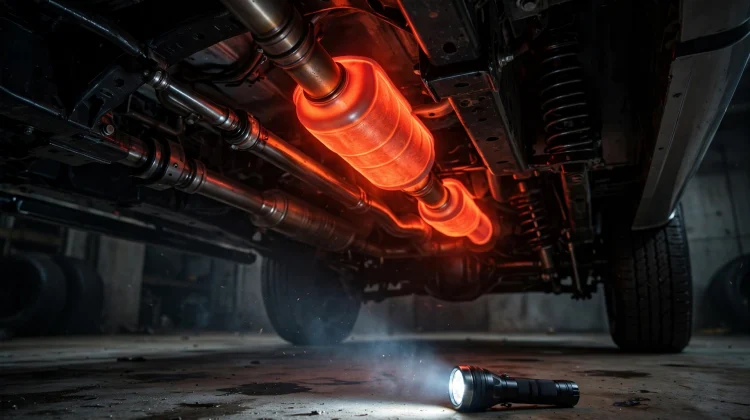
Your check engine light is on. You scan it. One code: P0420 — Catalyst System Efficiency Below Threshold (Bank 1) Your stomach drops. You Google it. Everyone says “new catalytic converter, $2,000.” Stop. Don’t authorize that repair yet. On a 2018 F-150, P0420 is one of the MOST misdiagnosed codes in existence. And Ford knows it — they issued THREE different TSBs and a recall just for this code. P0420 means your Bank 1 catalytic converter (passenger side) is not cleaning exhaust as well as the computer expects. It compares the upstream O2 sensor (before cat) vs downstream O2 sensor (after cat). If the downstream sensor starts switching as fast as the upstream, the cat is not storing oxygen anymore.
Most common cause IS a worn / poisoned cat, but on 2018 F-150 2.7L EcoBoost, the #1 cause is actually sulfur buildup + overly sensitive PCM calibration — fixed by Ford TSB 22-2260 / 24-2115 drive cycle, or Recall 24E12 PCM update. Next most common: exhaust leak, bad downstream O2 sensor, misfire / oil burning that killed the cat. You CAN drive short-term, but do NOT ignore for months — a clogged / broken cat can choke your engine and kill power. Fix in order: 1) Check other codes, 2) Check for Ford recall / TSB, 3) O2 waveform test, 4) Exhaust leak, 5) De-sulfate drive, 6) Replace cat LAST.
1. What Does P0420 ACTUALLY Mean? (The 60-Second Science)
Your truck has 2 O2 sensors per bank:
- Upstream O2 (Sensor 1, BEFORE cat): Sniffs raw exhaust. Should switch fast: 0.1V (lean) to 0.9V (rich), 2-3 times per second. It’s wild.
- Downstream O2 (Sensor 2, AFTER cat): Sniffs cleaned exhaust. Should be CALM: steady around 0.5V-0.7V, slow switches. Because the cat is supposed to store oxygen and smooth it out.
“The ECM compares the waveforms of the heated oxygen sensor (sensor 1) and heated oxygen sensor (sensor 2). While the TWC is functioning normally, the waveform of sensor 2 fluctuates more slowly than sensor 1. When sensor 2 waveform frequently fluctuates, it indicates TWC performance has deteriorated.” [Toyota / OBDII SFI System Diagnostic DTC P0420 — Monitor Description] “Technically, P0420 means the catalyst in the upstream converter isn’t storing oxygen as it should. Oxygen storage capacity is the best indicator of catalyst efficiency. When it drops, the PCM sets P0420.” [OBDAdvisor — P0420 Expert-Reviewed]
Think of it like this: Upstream sensor is a hyperactive kid jumping up and down. Downstream sensor should be a calm adult sitting on a couch. If the adult starts jumping up and down exactly like the kid, the couch (catalytic converter) is broken. It’s not filtering anything anymore. Bank 1 = Passenger Side. On ALL 2018 F-150s, Cylinder #1 is passenger side front. So P0420 = passenger side cat. P0430 = driver side cat (Bank 2). If you have BOTH P0420 + P0430, it’s not two bad cats at once — it’s something affecting both banks: bad gas, PCM calibration, sulfur, or engine running rich/lean on both sides. [Engine-Codes — P0420 Ford F-150]
2. Which Engine Do YOU Have? P0420 Is Different For Each
| Engine | Bank 1 Cat Location | #1 Cause of P0420 on THIS Engine | Ford TSB / Recall? |
| 2.7L EcoBoost V6 Twin-Turbo | Passenger side, bolted to turbo / manifold | Sulfur poisoning + PCM too sensitive — NOT dead cat. De-sulfate drive fixes it. Turbo oil leak can also poison cat. | YES — TSB 22-2137 / 22-2260 / 24-2115 + Recall 24E12 |
| 3.5L EcoBoost V6 Twin-Turbo | Passenger side | Oil consumption via PCV / turbo seal + misfire from bad plugs killing cat + exhaust leak | TSB 18-2346 (catalyst monitor) |
| 5.0L Coyote V8 | Passenger side, downstream of manifold | Aging cat + exhaust manifold leak + misfire | No specific P0420 TSB, but 8yr/80k warranty applies |
| 3.3L V6 Base | Passenger side | Aging cat + O2 sensor + exhaust leak | No specific TSB |
“On EcoBoost engines, turbo seal leaks can push oil into the exhaust and contaminate the converter prematurely. Ford TSB 18-2346 addresses catalyst monitor readiness and efficiency issues on certain EcoBoost applications.” [OBDAdvisor — Ford EcoBoost P0420] “Emission Recall 24E12 (NHTSA ID: 11014884) — 2018-2020 F-150 — Symptom: False low catalyst efficiency codes (DTCs P0420/P0430). Fix: Powertrain Control Module (PCM) software update.” [Go-Parts — 2018-2020 F-150 2.7L EcoBoost Problems / TSBs]
3. STOP — Check These 3 Ford Secrets BEFORE You Spend $1
SECRET #1: Recall 24E12 — Free PCM Update (2.7L EcoBoost, 2018-2020)
Ford admits: “Defective PCM calibration could, over time, reduce effectiveness of emissions control system and monitoring accuracy of catalytic converter’s efficiency.” [CarProblemZoo — 2019 F-150 Recall 24E12 Complaint, Sept 2026] Translation: Ford’s software was TOO sensitive and threw false P0420/P0430 even when cat was fine. The fix is a FREE PCM reflash at dealer. What to do: Go to Ford.com/recalls or NHTSA.gov, enter VIN, check if 24E12 is open. If yes, get it done FREE before you replace anything.
Many owners report P0420 disappeared after reflash — or, if cat was truly bad, it now shows constant instead of intermittent. [CarProblemZoo — Owner Reports, Sept 2026] WARNING: Some owners in 2026 report dealer quoted $6,000 for 2 cats AFTER 24E12 reflash, even though truck had zero lights before. If that happens to you, ask for Ford P01 financial review / after-warranty assistance, file NHTSA complaint, and get a second opinion with O2 waveform test below. Don’t just pay $6,000. [CarProblemZoo — 2020 F-150 2.7L, Sept 25 2026]
SECRET #2: TSB 22-2260 / 24-2115 — The “Drive It Hard” Fix (2.7L EcoBoost)
“Some 2018-2020 F-150 vehicles equipped with 2.7L EcoBoost may exhibit MIL with DTC P0420 and/or P0430. This may be due to high sulfur content in the fuel. To correct, follow Service Procedure to de-sulfate catalytic converters.” [OEMDTC — TSB 22-2260, Jan 31 2023] “This article supersedes TSB 22-2260… Some 2018-2020 F-150 2.7L may exhibit MIL with P0420/P0430. This may be due to calibration and controls sensitivity.
To correct, follow Service Procedure to perform catalyst stabilization drive cycle.” [OEMDTC — TSB 24-2115, April 23 2024] What is sulfur poisoning? Cheap gas has high sulfur. Sulfur coats the precious metals (platinum, palladium, rhodium) inside cat and blocks them. Cat looks dead, but it’s just dirty. Driving hard gets cat super hot and burns sulfur off. Ford’s Official De-Sulfate Procedure (TSB 22-2260):
- 1. Warm engine to normal operating temp.
- 2. Find a safe highway, 65 mph zone.
- 3. From 30 mph or slower, accelerate at WIDE OPEN THROTTLE (WOT) until you hit 65 mph.
- 4. Do periodic light accel / decel for 5 minutes, alternating 50 mph to 65 mph.
- 5. Repeat WOT runs for total ~30 minutes. [OEMDTC — TSB 22-2260 Service Procedure]
“Fix: Drive vehicle aggressively (with several wide-open throttle events) for about 30 minutes to de-sulfate catalytic converters.” [Go-Parts — Catalyst Efficiency Codes TSB 22-2137] Does it work? Yes, for sulfur poisoning. No, for melted / broken / truly dead cat. Try it once. If code comes back in 2-3 days, cat is truly dead or O2 sensor is bad.
SECRET #3: Federal Emissions Warranty — 8 Years / 80,000 Miles FREE Cat
“You may still have emissions warranty on that truck. Should be 8/80000 on cats.” [JustAnswer — Ford F-150 P0420/P0430] “Eligible original converters have federal emissions warranty protection for eight years or 80,000 miles.” [ThePricer — Catalytic Converter Replacement Cost 2026] 2018 F-150 = 8 years from in-service date. If your truck was first sold in late 2018, warranty may expire late 2026. CHECK NOW.
If you’re under 80k miles and under 8 years, Ford MUST replace cat FREE. Don’t pay $2,000. Call dealer with VIN, ask: “Is my catalytic converter covered under federal emissions warranty?” Get it in writing. Some states (California, Colorado, New York, Maine) have longer CARB warranty — up to 7yr/70k for some parts, 15yr/150k for PZEV. Check your underhood emissions sticker: if it says CARB / California, you may have extra coverage. [EGR Performance — F-150 Catalytic Converter FAQ]
4. Can You Still Drive With P0420?
| Situation | Can You Drive? |
| P0420 only, truck runs fine, no loss of power, no rattling | YES — short term. “You won’t damage engine immediately, but continued driving accelerates converter degradation and you’ll fail emissions.” [OBDAdvisor] Fix within 2-4 weeks. |
| P0420 + P0300 misfire, flashing CEL, shaking | NO — STOP. “A flashing check-engine light or active misfire can overheat a catalytic converter in a short period.” [SPELAB — Catalytic Converter Problems] Raw fuel melts cat in minutes. |
| P0420 + loss of power uphill / towing, won’t go over 60 mph | NO — Clogged cat. “A melted or plugged converter will choke exhaust flow, kill power under load.” [EGR Performance] Backpressure can damage engine. |
| P0420 + rattling from under truck, rotten egg smell | NO — Cat brick broken. Pieces can clog exhaust, get sucked back. Tow it. |
| P0420 for months, ignored | You’re risking it. Cat gets worse, fuel economy drops, you fail emissions, and if it clogs, you pay for tow + cat + possible engine damage. |
5. Symptoms Checklist
- ☐ Check Engine Light on (solid)
- ☐ No symptoms at all (most common — just light)
- ☐ Slightly worse gas mileage (1-3 MPG)
- ☐ Rotten egg / sulfur smell from exhaust
- ☐ Rattling / metallic noise under truck (broken cat brick)
- ☐ Loss of power uphill / towing (clogged cat)
- ☐ Failed emissions test
- ☐ P0420 + P0430 together
- ☐ P0420 + P0171 / P0174 lean, P0172 / P0175 rich, P0300 misfire — fix THOSE first, they kill cats
“P0420 will often be thrown if one of your truck’s oxygen sensors is not functioning correctly.” [700R4TransmissionHQ — Ford F-150 P0420] But also: “P0420 is the most common OBDII code and is virtually never a breakdown risk.” [700R4TransmissionHQ]
6. Tools You Need
- OBD2 Scanner with LIVE DATA + GRAPH — 25-40 (BlueDriver, Autel AL519, or Bluetooth + Torque Pro). You NEED to graph O2 sensors. A free code reader is NOT enough.
- Infrared Thermometer — $20 (for cat temp test)
- Basic socket set, O2 sensor socket (22mm), penetrating oil (PB Blaster)
- Flashlight, gloves, jack + jack stands if you go under truck
7. THE O2 WAVEFORM TEST — This Tells You If Cat Is Dead In 5 Minutes
This is the Ford / Toyota factory test. Don’t replace cat without doing this. “Live data analysis is crucial: Monitoring upstream and downstream O2 sensor waveforms provides vital clues. A downstream sensor mirroring upstream’s rapid fluctuations points to failing cat, while erratic or stuck downstream signal suggests sensor issue.” [AGRCars — P0420 Code: Is Your Cat Really Failing?] Step 1: Engine warm, fully warmed up (coolant 190°F+). Drive 10 min highway. Step 2: Scanner -> Live Data -> Graph: O2S B1S1 (upstream) and O2S B1S2 (downstream). Step 3: Hold RPM at 2500 for 2 minutes, then idle. Watch graphs.
| What You See | What It Means | Fix |
| Upstream: switches fast 0.1-0.9V. Downstream: steady 0.5-0.7V, slow | CAT IS GOOD. Cat is storing oxygen. P0420 is false / intermittent / sulfur / O2 sensor glitch. Do de-sulfate drive + check for exhaust leak. | Don’t replace cat! |
| Upstream: switches fast. Downstream: switches fast TOO, mirrors upstream almost exactly | CAT IS DEAD. “If downstream closely mimics front sensors, converters aren’t working.” [V8SHO — P0420 Diagnostic] “Downstream waveform closely mirrors upstream’s rapid fluctuations; very little difference.” [AGRCars] | Replace cat (after fixing root cause) |
| Downstream: stuck at 0.1V or 0.9V, flatline, never moves | DOWNSTREAM O2 SENSOR DEAD. Sensor not reading, PCM thinks cat is bad. “Stuck high/low, flatline, or erratic, not consistently mirroring upstream.” [AGRCars] | Replace downstream O2 sensor (60-120), NOT cat |
| Downstream: erratic, jumps randomly, noisy | O2 sensor wiring / connector / heater bad. Check wiring, connector, heater codes P0135 / P0141. | Fix wiring / sensor |
Pro Tip: Do this test AFTER de-sulfate drive + after checking for exhaust leaks. Sulfur can make a good cat look dead for a day.
8. FIX #1 — Exhaust Leak (Free To $150, Check FIRST)
“An exhaust leak can cause P0420 since it causes exhaust gases to escape unmetered.” [700R4TransmissionHQ] “Exhaust leaks, sensor faults, misfires, and fuel-trim problems can trigger same codes.” [SPELAB] Where leaks happen on 2018 F-150:
- Exhaust manifold gasket (passenger side) — ticking when cold, black soot
- Manifold to cat flange — rusted bolts, broken studs
- Cat to mid-pipe flange — loose / rusted
- Flex pipe (if equipped) — cracked
How to find: Cold engine, start it, feel around joints with gloved hand (careful, hot fast) for puffing air. Listen for ticking / hissing. Look for black soot marks. Use soapy water spray — bubbles = leak. Cost: Gasket 15-40, Bolts $10, Labor 100-200 if shop. Don’t replace cat if you have an exhaust leak — new cat will still throw P0420 because air is leaking in before downstream O2 sensor.
9. FIX #2 — Downstream O2 Sensor (Bank 1 Sensor 2) — 60-120
“A bad downstream O2 sensor or exhaust leak can throw same code for far less.” [OBDAdvisor] “Check for exhaust leaks first (repair cost: under 10forsealant).ThentestdownstreamO2sensor(20-95toreplace).Onlyreplaceconverter(400-$2,000+) after ruling out cheaper causes.” [OBDAdvisor — Cheapest Way To Fix P0420] When O2 sensor IS the problem:
- Downstream O2 stuck / flatline / erratic in waveform test
- You have P0136 / P0137 / P0140 / P0141 (O2 heater / circuit codes) alongside P0420
- Sensor wiring damaged, corroded, melted on exhaust
- Sensor is 100k+ miles old and slow to respond
When O2 sensor is NOT the problem: Downstream mirrors upstream perfectly + no O2 codes + cat temp test shows no heat rise. That’s dead cat, not sensor. “Replacing only O2 sensor rarely resolves persistent P0420/P0430 codes.” [JustAnswer — 2018 F-150 P0430] Location: Bank 1 Sensor 2 = passenger side, AFTER cat, in exhaust pipe. Use O2 sensor socket, PB Blaster, warm engine (not hot). Use Motorcraft / NTK / Bosch OEM, not $20 cheap sensor — cheap sensors lie and throw P0420 again.
10. FIX #3 — The Cat Temperature Test (IR Thermometer, 2 Minutes)
A working cat creates heat — chemical reaction = exothermic. Inlet should be cooler than outlet. How: Engine warm, idle 2 min, then 2500 RPM 2 min. Point IR thermometer at cat inlet (before cat) and outlet (after cat).
| Result | Meaning |
| Outlet 50-100°F HOTTER than inlet (e.g., 500°F in, 600°F out) | CAT WORKING. Chemical reaction happening. Don’t replace. |
| Outlet same as inlet, or cooler | CAT DEAD / NO REACTION. “Little to no temp difference, or outlet even cooler, indicating no chemical reaction.” [AGRCars] |
| Inlet super hot (800°F+), outlet cooler, loss of power | CAT CLOGGED / MELTED. Exhaust can’t get through. Backpressure building. |
11. FIX #4 — Find What KILLED The Cat (Don’t Replace Cat Without This)
“The killer is never age alone; it is unburned fuel, coolant leaks, and oil consumption that poison ceramic honeycomb substrate. Once washcoat gets contaminated or brick melts from misfire, no cleaning service will bring it back.” [EGR Performance] “A converter gets replaced before root cause gets fixed. That can burn up new part fast, especially on hard-worked F-150.” [SPELAB] The 5 Cat Killers on 2018 F-150:
- 1. Misfire (P0300-P0308): Unburned fuel dumps into cat, cat overheats to 2,000°F+, melts brick. Fix: coils, plugs, injectors. 2018 F-150 plugs: EcoBoost 60k-100k, 5.0 100k. If you had flashing CEL, cat is likely dead.
- 2. Oil Burning / PCV / Turbo Seal Leak: Oil coats precious metals, poisons cat. EcoBoost: PCV system, turbo seals. Check oil consumption — if you’re adding 1 quart every 1,000 miles, that’s killing cat. Fix PCV, turbo seals, catch can helps but not cure.
- 3. Running Rich (P0172 / P0175): Too much fuel = cat overheats. Fix: O2 sensor, MAF, fuel pressure, injector leak.
- 4. Running Lean (P0171 / P0174): Too much air = cat overheats, plus misfire. Fix: vacuum leak, MAF, PCV.
- 5. Coolant Leak (Head Gasket / Intake): Coolant (ethylene glycol) poisons cat instantly. If you have white smoke, coolant loss, milky oil, fix that FIRST.
Rule: If you replace cat without fixing misfire / oil burning / rich / lean, new cat will die in 3-6 months and you’ll pay again. Always fix other codes FIRST. “If any DTCs other than P0420 are output, troubleshoot those DTCs first.” [OBDII Diagnostic P0420]
12. FIX #5 — Replace Catalytic Converter (LAST Resort, Do It Right)
When cat is truly dead: waveform mirrors upstream + temp test shows no heat + no exhaust leak + O2 sensor good + de-sulfate didn’t help + recall done + warranty expired.
What Type To Buy?
| Type | Price (Parts) | Pros / Cons |
| OEM Ford / Motorcraft | 1,200-2,000 per side | Best fit, best efficiency, will pass emissions, lasts 100k+. Expensive. |
| Direct-Fit EPA (Walker, MagnaFlow, Eastern) | 300-700 per side | “A good bolt-on aftermarket unit (Walker or similar) can be as little as $300.” [OBDAdvisor] “Choose direct-fit over universal unless modifying.” [CarInterior — F-150 Cat Guide] Good for most states. |
| Universal / Weld-In | 150-300 | Cheapest, needs welding, may not fit, may throw P0420 again if not OBD-II compliant. Don’t use unless you’re a welder. |
| High-Flow / Performance Cat | 400-800 | “After installing high-flow cat, O2 sensors may detect abnormal flow, causing code.” [JustAnswer — F-150 EcoBoost High-Flow Cat] Often throws P0420 again. Avoid unless tuned. |
| Used / Junkyard | 200-500 | Risky — may be already dead, no warranty, may be stolen cat. Don’t. |
EPA vs CARB: “Converters in this collection are EPA-compliant, 46-state aftermarket units. They are NOT CARB-certified, so NOT legal for California or Colorado, and buyers in New York and Maine must confirm truck runs federal emissions.” [EGR Performance] Check your underhood emissions sticker BEFORE ordering. If it says CARB, you MUST buy CARB cat or you’ll fail smog. Bank 1 Cat Part Numbers (Verify With VIN): 2018 F-150 cats are VIN-specific by engine + emissions. Common Ford numbers: 2.7L — JL7Z-5E212-… / JL1Z-5E212-…, 3.5L — HL3Z-5E212-…, 5.0L — JL3Z-5E212-… Always verify on FordParts.com with VIN — mid-year changes exist. DIY vs Shop:
- DIY: Possible if direct-fit bolt-on, you have jack stands, PB Blaster, O2 socket, and patience for rusted bolts. 2-4 hours. Save $300 labor. Risk: broken studs, exhaust leak if not sealed.
- Shop: Recommended if bolts are rusted, cat is welded, or you have 4WD / skid plates. Labor 236-347 national average. [ThePricer / RepairPal Sept 2026]
Cost Guide (Real 2026 Numbers):
| Repair | DIY Cost | Shop Cost |
| Exhaust leak gasket / bolts | 15-50 | 100-250 |
| Downstream O2 sensor B1S2 | 60-120 | 200-350 |
| PCM Recall 24E12 reflash | Free at dealer | Free |
| De-sulfate drive | Free (gas only) | Free |
| Direct-fit EPA cat (1 side) | 300-700 | 600-1,200 |
| OEM Ford cat (1 side) | 1,200-2,000 | 1,500-2,500 |
| Both cats (2.7L / 3.5L / 5.0L) | 600-1,400 (aftermarket) / 2,400-4,000 (OEM) | 1,591-1,656 average for F-150 (RepairPal) [JunkCarsUS / RepairPal Sept 2026] / 2,280-2,480 national average [ThePricer] / Dealer quote $6,000 for 2 cats reported by owners [CarProblemZoo] |
“Catalytic converter replacement commonly costs about 1,000-4,000 in US, including parts and labor.” [JunkCarsUS — Cat Replacement Cost 2026] “A replacement for Ford F-150 might cost around $1,200.” [AutoDana]
13. Step-By-Step: The Exact Order To Fix P0420 (Print This)
- STEP 0: Scan, write down ALL codes, freeze frame. DO NOT clear yet. If you have P0300 misfire, P0171 lean, P0172 rich, P0400 EGR, fix those FIRST.
- STEP 1: Check VIN for Recall 24E12 + warranty 8yr/80k. If open / covered, go to dealer FREE. Don’t pay for cat.
- STEP 2: Visual + listen for exhaust leak. Fix leak if found. Cost 15-150.
- STEP 3: O2 waveform test (Section 7). If downstream flatline / erratic, replace downstream O2 sensor. If downstream mirrors upstream, go to Step 4.
- STEP 4: Cat temp test (Section 10). If outlet hotter, cat is good — don’t replace.
- STEP 5 (2.7L ONLY): Do Ford de-sulfate drive: WOT 30 mph to 65 mph, repeat for 30 min. Clear code, drive 2-3 days. If code stays off, you’re fixed (sulfur).
- STEP 6: Check what killed cat: misfire, oil burning, rich/lean, coolant. Fix root cause.
- STEP 7: If waveform still mirrors + temp test fails + no leak + O2 good + de-sulfate failed + warranty expired, replace Bank 1 cat (direct-fit EPA or OEM, CARB if needed). Replace O2 sensors at same time if 100k+ miles (good practice).
- STEP 8: Clear codes, drive 50-100 miles, do emissions drive cycle: Cold start, idle 2 min, 55 mph steady 5 min, city 10 min, highway 10 min. Check monitors ready. Then smog test.
14. The Traps — Don’t Fall For These
| Trap | Truth |
| Replace cat first, ask later | “P0420 and P0430 are catalyst-efficiency codes, not automatic replacement orders.” [SPELAB] 40% are O2 / leak / sulfur / PCM. |
| Cat cleaner in a bottle ($20) will fix it | No. “No cleaning service will bring it back” once washcoat is contaminated or brick melted. [EGR Performance] Cleaner may help mild sulfur, but not dead cat. Don’t waste $20 x 5 bottles. |
| O2 spacer / defouler / tune to turn off P0420 | “No legitimate tune eliminates P0420 without also removing emissions compliance. In most states, disabling catalyst monitor is illegal.” [OBDAdvisor] You’ll fail smog, and if you sell truck, it’s fraud. |
| Cheap universal cat welded in | Often not OBD-II compliant, throws P0420 again in 2 weeks. Buy direct-fit EPA / CARB. |
| Replace O2 sensor and hope | “Replacing oxygen sensors before diagnosis is a mistake that could damage other parts.” [GuideMechanic — F-150 P0420] Test first. |
| Ignore P0420 because truck runs fine | Cat gets worse, clogs, kills power, fails emissions, and if brick breaks, pieces can damage engine. |
| Use non-sensor-safe silicone sealant | Silicone kills O2 sensors and cats. Use ONLY sensor-safe sealant. [V8SHO] |
15. How To PREVENT P0420 From Coming Back
- Fix misfires IMMEDIATELY. Flashing CEL = pull over, tow. Don’t drive 20 miles with misfire.
- Use Top Tier gas. Low sulfur, keeps cat clean. Avoid cheap no-name gas with high sulfur.
- Fix oil burning early. PCV, turbo seals, valve seals. Check oil every 1,000 miles. If you’re burning 1 quart / 1k, fix it.
- Change oil on time, use Ford spec oil. 2.7L EcoBoost: 5W-30 full synthetic, Ford WSS-M2C961-A1. Wrong oil kills wet belt + poisons cat. [Go-Parts — 2.7L EcoBoost]
- Don’t ignore P0171 / P0172. Lean / rich kills cats. Fix those codes within a week.
- Drive hard occasionally. Highway WOT runs burn sulfur off cat. Short trips only = sulfur buildup. Take it on highway once a week.
- Replace plugs / coils on schedule. EcoBoost 60k-100k, 5.0 100k.
Can I drive with P0420?
Yes, short-term if no misfire, no loss of power, no rattling. Fix within 2-4 weeks. You’ll fail emissions.
Will P0420 fail emissions / inspection?
Yes. Any check engine light = fail in most states. Fix it, drive 50-100 miles to set monitors, then test.
P0420 + P0430 together — both cats dead?
Unlikely both died at same time. More likely: bad gas / sulfur, PCM calibration, engine running rich/lean on both banks, or Recall 24E12. Do de-sulfate + PCM update + check fuel trims first.
Can a bad O2 sensor cause P0420?
Yes, downstream O2 sensor stuck / slow / wiring bad can cause false P0420. Test waveform first. Upstream O2 bad usually causes P0171 / P0172, not P0420 alone.
Can I clear P0420 and pass smog?
No. Smog test checks monitors — if you just cleared, monitors are “not ready” and you’ll fail. Need to drive 50-100 miles to set monitors. If cat is dead, code will return.
My 2018 F-150 2.7L has P0420, dealer says $6,000 for 2 cats, truck had no light before recall. What do I do?
Get second opinion with O2 waveform + temp test. Ask for Ford after-warranty assistance (P01), file NHTSA complaint, check if cat is actually dead or just PCM sensitivity. Many owners report this exact pattern after 24E12. [CarProblemZoo — Sept 2026] Bottom Line: P0420 is not automatically a $2,000 cat. On a 2018 F-150, check recall 24E12, warranty 8yr/80k, exhaust leak, O2 waveform, and de-sulfate drive FIRST. Those 4 things fix 40% of P0420s for 0-120. If cat is truly dead — waveform mirrors upstream, temp test fails, no leak, O2 good — then replace it, but fix what killed it first or new cat will die too. Did this fix your truck? Comment: Your engine (2.7 / 3.5 / 5.0 / 3.3), your mileage, did you have Recall 24E12, and what fixed it — de-sulfate drive, O2 sensor, exhaust leak, or new cat? Your comment will save the next F-150 owner $2,000.
P0420 Code on 2018 Ford F-150: Diagnosis & Fix Guide
DTC P0420 stands for Catalyst System Efficiency Below Threshold (Bank 1). While a worn or contaminated converter is a common cause on older vehicles, 2018 F-150s frequently trigger this code due to sulfur buildup, exhaust leaks, or overly sensitive PCM software calibration.
Quick Diagnostic Triage Order
- Check for other codes: Always fix misfires (P0300) or rich/lean codes (P0171/P0172) first.
- Check Ford Recall 24E12 & Warranty: Free PCM update or 8-yr/80k federal emission coverage.
- Inspect for Exhaust Leaks: Upstream air leaks trick the downstream O2 sensor.
- O2 Sensor Waveform Test: Verify downstream sensor behavior with live data.
- De-sulfate Drive Cycle (2.7L EcoBoost): Perform Ford TSB 22-2260 drive procedure.
- Replace Catalytic Converter: Only replace after ruling out software, leaks, and sensors.
1. Engine Specifics & Common Root Causes
| Engine | Bank 1 Location | Top #1 Cause of P0420 | Ford Recall / TSB |
|---|---|---|---|
| 2.7L EcoBoost V6 | Passenger side (Turbo outlet) | Sulfur poisoning / Sensitive PCM calibration | Recall 24E12 / TSB 24-2115 |
| 3.5L EcoBoost V6 | Passenger side | Oil fouling (turbo seal/PCV) or spark plug misfires | TSB 18-2346 |
| 5.0L Coyote V8 | Passenger side manifold outlet | Exhaust manifold leaks / High-mileage cat wear | 8-Yr / 80k Warranty Applies |
| 3.3L Duratec V6 | Passenger side | Downstream O2 sensor fault / Exhaust leak | Standard OBD-II protocol |
2. Ford Recalls & TSB Procedures
Recall 24E12 (Free PCM Software Update)
Ford issued Recall 24E12 for 2018–2020 F-150s with the 2.7L EcoBoost because the factory PCM calibration was overly sensitive, throwing false P0420/P0430 codes when the catalytic converter was functioning properly. Dealerships will reprogram the PCM free of charge.
TSB 22-2260 / 24-2115: De-Sulfating Drive Procedure (2.7L EcoBoost)
High sulfur content in fuel can coat the precious metal washcoat inside the catalyst. To clear sulfur fouling according to Ford technical service bulletins:
- Bring the engine up to full operating temperature.
- Perform Wide-Open Throttle (WOT) accelerations from 30 mph to 65 mph on an open highway.
- Maintain steady speeds between 50 mph and 65 mph for 5-minute intervals.
- Repeat WOT cycles periodically over a 30-minute drive to burn off sulfur deposits.
3. O2 Sensor Live Data Waveform Diagnosis
Connect an OBD2 scanner capable of graphing live data. Warm the engine, hold RPM at 2,500 for two minutes, and inspect Bank 1 Sensor 1 (Upstream) vs Bank 1 Sensor 2 (Downstream):
Healthy Converter: Upstream oscillates rapidly (0.1V to 0.9V). Downstream remains smooth and steady around 0.45V to 0.70V. Failing Converter: Downstream sensor mirrors the rapid switching of the upstream sensor. Faulty Downstream Sensor: Voltage stays flatlined at 0.0V, 0.9V, or shows erratic jumps regardless of throttle input.
4. Repair Cost Breakdown
| Fix Type | DIY Cost | Professional Shop Cost |
|---|---|---|
| PCM Reflash (Recall 24E12) | Free (Dealer) | Free (Dealer) |
| Exhaust Leak Repair (Gasket/Flange) | $15 – $50 | $100 – $250 |
| Downstream O2 Sensor (B1S2) | $60 – $120 | $200 – $350 |
| Direct-Fit EPA Catalytic Converter | $300 – $700 | $600 – $1,200 |
| OEM Ford Catalytic Converter | $1,200 – $2,000 | $1,500 – $2,500+ |
📌 Federal Emission Warranty Reminder: OEM catalytic converters are covered under the U.S. Federal Emissions Warranty for 8 years or 80,000 miles (whichever comes first). If your 2018 F-150 meets these criteria, repairs must be performed by an authorized Ford dealer at no charge.